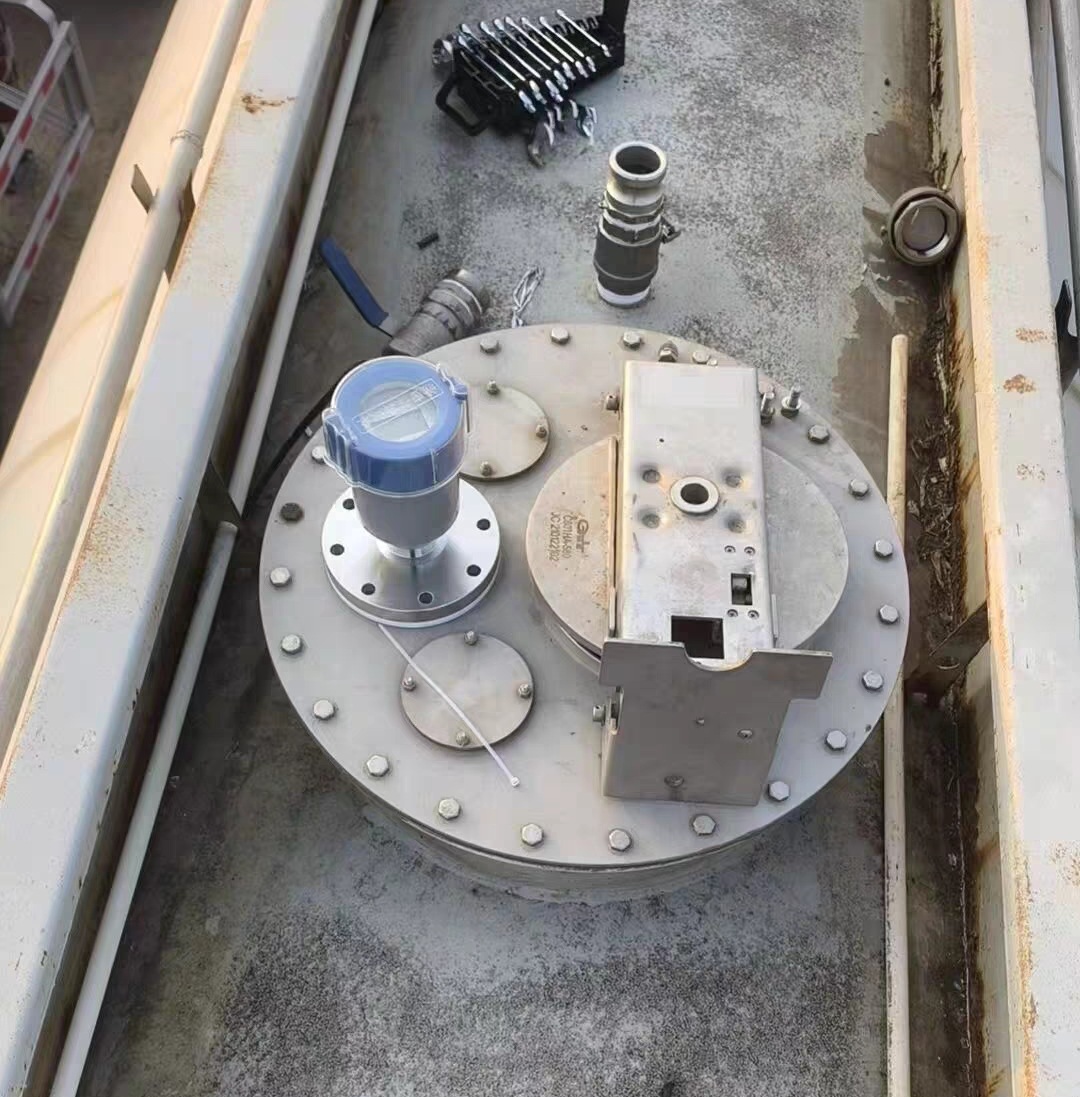
A storage tank in the Fine Powder Division of a chemical plant has an on-site measurement range of 25 meters. It contains an internal agitator and heating system. During feeding, high-pressure steam is present; when staff open the inspection hatch, they can see intense steam escaping. Previously, a guided-wave radar level transmitter was used at the site, but its performance was poor due to factors such as the corrosiveness and viscosity of the measured medium.
1. Site Conditions Diagram
Application of 80GHz Radar Level Transmitters in Special Conditions—High-Temperature Steam and Agitated Liquids Application of Weidu 80GHz Radar Level Transmitters in Special Conditions—High-Temperature Steam and Agitated Liquids
Equipped with agitators and heating devices, with significant steam
2. Instrument Historical Trend Chart
Application of 80GHz Radar Level Transmitters in Special Conditions—High-Temperature Steam and Agitated Liquids
Some ask why 80GHz high-frequency radar level transmitters must be selected for high-steam, agitated liquid conditions—can 26GHz radar level transmitters measure these conditions?
A senior engineer from Brown Instrumentation & Control explains: The 80GHz radar has a higher transmission frequency, offering excellent penetration and being unaffected by steam; The 20-degree beam angle effectively avoids interference from agitator blades; its unique echo tracking algorithm (echo locking function) prevents the instrument from reading multiple echoes at high liquid levels.
In contrast, in high-steam environments, 26GHz radar level transmitters either cannot penetrate the steam, or the echo is significantly weakened after reaching the medium interface, resulting in unstable measurements; Additionally, 26GHz radar level transmitters typically have a transmission angle of 20 degrees or more, making the radar waves highly susceptible to interference from agitator blades, which can cause false alarms; furthermore, at high material levels, where there is no internal steam and the measurement range is large, the echoes are very strong, making it easy to detect multiple echoes. As shown in the figure below:
Applications of 80 GHz radar level transmitters in special operating conditions—such as high-temperature steam and stirred liquids—mean that customers typically choose 80 GHz radar level transmitters for level measurement in environments with high steam and stirring.