- Welcome to Brown instruments (Jiangsu) Co., Ltd official website!

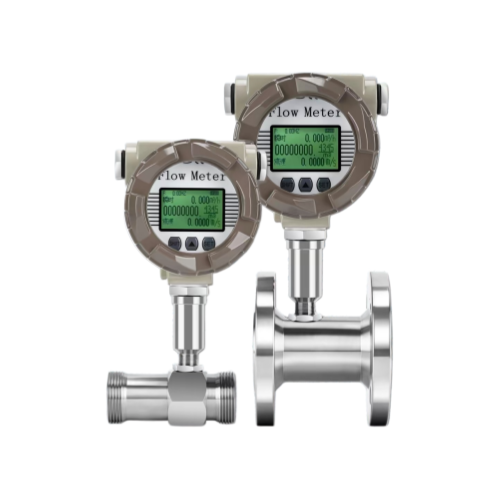
Product Overview:The LWGY Series Liquid Turbine Flowmeter is a velocity-type flow instrument based on the principle of angular momentum conservation. Fluid impact causes the turbine blades to rotate, with the turbine's rotational speed varying according to flow rate. The flow value is ultimately
Product Overview:
The LWGY Series Liquid Turbine Flowmeter is a velocity-type flow instrument based on the principle of angular momentum conservation. Fluid impact causes the turbine blades to rotate, with the turbine's rotational speed varying according to flow rate. The flow value is ultimately calculated from the turbine's revolutions.
The LWGY series turbine flowmeter is an optimized turbine flowmeter featuring a simple, lightweight design with high accuracy and repeatability. It is particularly suitable for industries such as sanitation, food processing, pharmaceuticals, fine chemicals, and petroleum.
It can measure liquids free of impurities, with low viscosity (kinematic viscosity below 10 mm²/s), and without strong corrosiveness. The explosion-proof model can be directly installed in combustible and explosive environments.
Working Principle:
Turbine flow meters utilize a turbine for measurement. They first convert flow velocity into turbine rotational speed, then convert this rotational speed into an electrical signal proportional to flow rate. This type of flow meter is used to detect instantaneous flow and total accumulated flow, with its output signal being a frequency that is easily digitized. The sensing coil and permanent magnet are fixed together within the housing. As the ferromagnetic turbine blades pass the magnet, the magnetic resistance of the magnetic circuit changes, generating an induced signal. The signal is amplified and shaped by an amplifier before being sent to a counter or frequency meter to display the total accumulated flow. Simultaneously, the pulse frequency undergoes frequency-to-voltage conversion to indicate instantaneous flow. The turbine's rotational speed is proportional to the flow rate, and the number of revolutions is proportional to the total volume of fluid passing through. The turbine flow meter outputs a frequency-modulated signal, which not only enhances the detection circuit's resistance to interference but also simplifies the flow detection system.
Instrument Features:
High accuracy, typically reaching ±1.0%;
Excellent repeatability, with short-term repeatability reaching 0.2% to 0.05%. Frequent or online calibration can achieve even higher accuracy.
The output pulse frequency signal is suitable for total volume measurement and computer connection, with no zero drift and strong anti-interference capabilities.
The original pulse frequency range (10.0Hz to 1.5kHz) provides excellent signal resolution.
The rangeability is wide, typically 10:1, with a maximum range of 20:1.
The compact and lightweight structure allows for easy installation and maintenance, with a large flow capacity.
Suitable for high-pressure measurement, no holes are required in the sensor body, making it easy to manufacture high-pressure instruments, such as 15MPa, 25MPa, and 40MPa.
Strong resistance to electromagnetic interference and vibration.
Low pressure loss, saving power consumption.
Customization is available for high temperatures up to 180°C and low temperatures up to -200°C.
Technical Specifications:
| Item | Data |
| Medium | Non-corrosive low velocity liquid without impurity,not suitable for gas/steam |
| Accuracy | ±1.0%,±0.5% |
| Flange standard | GB/T 9119-2010, DIN, ANSI, JIS |
| Output | Pulse, 4-20mA analog output, RS485 (Modbus-RTU protocol), HART |
| Diameter and installation | Flange connection DN15-DN200 |
| Screw connection: DN4-DN50 | |
| Loose flange connection: DN4-DN200 | |
| Medium temperature | Default type T1: -20℃~+80℃ (Standard) |
| High temp. type T2: -20℃~+120℃ (OEM) | |
| High temp. type T3: -20℃~+180℃(OEM) | |
| Operation condition | Operating temperature: -20℃~+60℃ |
| Related humidity: 5%~90% | |
| Atmospheric pressure: 86kPa~106kPa | |
| Ingress protection | IP65 or IP68 |
| Explosion proof | Exia‖CT4 or Exd‖BT6 |
| Warranty | 1 year |
Flow Meter:
| Nominal Diameter(DN)mm | Flow range | Connection Method | Nominal Pressure(MPa) | ||
| Expanded Flow | Standard Flow Rate | ||||
| 4 | 0.04~0.25 | Threaded connection | 10 6.3 | ||
| 6 | 0.1~0.6 | Threaded connection | |||
| 10 | 0.2~1.2 | Threaded connection | |||
| 15 | 0.4~8 | 0.6~6 | Threaded/Flange Connection | 6.3 2.5 1.6 | |
| 20 | 0.45~9 | 0.8~8 | Threaded/Flange Connection | ||
| 25 | 0.5~10 | 1~10 | Threaded/Flange Connection | ||
| 32 | 0.8~15 | 1.5~15 | Threaded/Flange Connection | ||
| 40 | 1~20 | 2~20 | Threaded/Flange Connection | ||
| 50 | 2~40 | 4~40 | Flange connection | 2.5 1.6 | |
| 65 | 4~70 | 7~70 | Flange connection | ||
| 80 | 5~100 | 10~100 | Flange connection | ||
| 100 | 10~200 | 20~200 | Flange connection | ||
| 125 | 13~250 | 25~250 | Flange connection | ||
| 150 | 15~300 | 30~300 | Flange connection | ||
| 200 | 40~800 | 80~800 | Flange connection | ||
| 250 | 100~1200 | 120~1200 | Flange connection | ||
| 300 | 180~2000 | 200~2000 | Flange connection | ||
Advantages and disadvantages:
| Turbine Meter Advantages | Turbine Meter Disadvantages |
| Wide flow rangeability including low flow rates | Requires constant backpressure to prevent cavitation |
| Turndown ratio is up to 35:1 | Accuracy adversely affected by bubbles in liquids |
| Good level of accuracy at an economic price | Turbine meters can be used with clean liquids and gases only |
| Simple, durable construction | Not applicable for measuring corrosive fluids |
| Easy to install and maintain | Requires a turbulent flow profile (consistent fluid velocity across the pipe diameter) for accuracy |
| Flexible connection to flow instruments for flow control | Sensitive to changes in fluid viscosity |
| Wide variety of process connections | Require a straight run of pipe before and after the turbine meter to allow swirl patterns in the flow stream to dissipate |
| Turbine meters can operate over a wide range of temperatures and pressures | |
| Low pressure drop across the turbine | May not function properly with high viscosity fluids where the flow profile is laminar |
| Provides a convenient signal output |
Applicable Media:
•Refined oil products, light crude oil, gasoline, light oil, jet fuel, light diesel oil, naphtha, ethylene, etc.
•Lubricating oil, hydraulic oil, etc.
•Water, pure water, distilled water, deionized water, desalinated water, softened water, etc.
•Alcohol, benzene, toluene, xylene, butadiene, carbon tetrachloride, methylamine, acrylonitrile, etc.
•Formaldehyde, acetic acid, caustic soda, carbon disulfide, etc.
•Milk, coffee, etc.
•High-temperature media such as thermal oil, thermal kerosene, etc.