- Welcome to Brown instruments (Jiangsu) Co., Ltd official website!

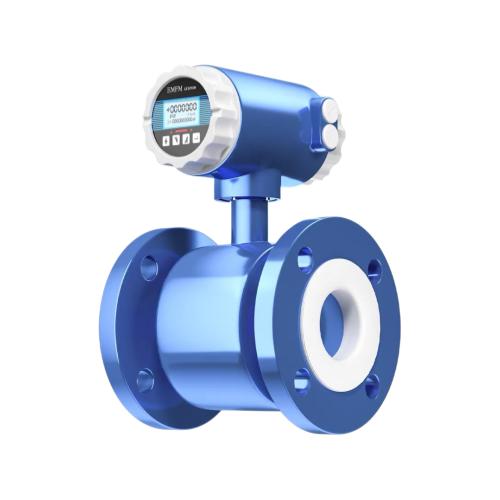
Working Principle:Electromagnetic flowmeters are instruments based on Faraday's law of electromagnetic induction, capable of measuring the volumetric flow rate of conductive fluids. They consist of two components: an electromagnetic flow sensor and an electromagnetic flow transmitter. Based on
Working Principle:
Electromagnetic flowmeters are instruments based on Faraday's law of electromagnetic induction, capable of measuring the volumetric flow rate of conductive fluids. They consist of two components: an electromagnetic flow sensor and an electromagnetic flow transmitter. Based on installation structure, they can be categorized into integrated and split types. This product offers stable and reliable performance with minimal interference from flow patterns. It employs a new ultra-low power consumption microprocessor, featuring high integration, fast processing speed, and high calculation accuracy. Suitable for measuring the flow of conductive liquid media in closed pipelines, it is widely used in industries such as chemical engineering, petroleum, municipal utilities, metallurgy, textiles, papermaking, pharmaceuticals, food processing, environmental protection, and water conservancy construction.
Product Features:
-Various connection methods: Flange, wafer, thread, tri-clamp, insertion.
-Wide turn-down ratio: Up to 1500:1.
-Varies connection standard: GB, DIN, ANSI, JIS.
-Multiple liner material options: Hard rubber, PTFE, Polyurethane, PFA (PFA lining with metal meshes vacuum resistant).
-Various electrode material options: 316L, Hastelloy-C22, Hastelloy-B10, titanium, tantalum, platinum/iridium Alloy, Stainless steel coated with tungsten carbide.
-Detachable electrode structure: Online maintenance and replacement of electrodes.
-Protection grade: Support IP65, IP67, IP68.
-Remote converter: Suitable for separate installation for column or wall mounting requirements
-Various output/input signals: Analog current, frequency, pulse.
-Various alarm functions: Support self-check and self-diagnosis functions such as fluid empty pipe, excitation circuit breaker, and flow rate over/lower limit alarm.
-Various communication types: RS232, RS485, HART, Profibus-DP
-Explosion-proof certification: Support ExdIICT6Gb
Technical Specifications:
| Diameter | DN3-DN3000 |
| Electrode Material | SS316L, Hb, Hc, Ti, Ta, Pt |
| Liner Material | Hard rubber, Polyurethane, PTFE, F46, PVDF, |
| Medium Conductivity | ≥5μs/cm as default |
| Accuracy | ±0.5% ; ±1.0% |
| Velocity Range | 0.3-12m/s |
| Ambient Temperature | -20℃~+60℃ |
| Medium Temperature | Rubber: ≤80℃ |
| PTFE & F46: ≤120℃ | |
| PFA: ≤180℃ | |
| Nominal Pressure | 0.6MPa~4.0MPa (according to caliber or special order) |
| Protect Level | IP65, IP67, IP68 (remote type) |
| Output | Pulse, 4-20mA, flow rate alarm |
| Communication | Modbus, HART, Profibus DP |
| Power Supply | 24V DC, 220V AC, Battery |
| Structure | Compact Type, Remote Type |
| Process Connection | Flange (DIN, ANSI, JIS, etc.) |
| Flange Wafer Type | |
| Sanitary Tri-clamp Type | |
| Thread Type | |
| Insertion Type | |
| Body Material | Carbon Steel, SS304 (SS316 as optional) |
Electrode material:
| Materials | Corrosion Resistance |
| Stainless Steel 316L | Applicable for: 1. Domestic water, industrial water, raw well water, municipal wastewater 2. Weakly corrosive acid, alkali, and salt solutions |
| Hastelloy B (HB) | Applicable: 1. Non-oxidizing acids, such as hydrochloric acid (concentration below 10%) 2. Alkalis (partial), such as sodium hydroxide (concentration below 50%) and all concentrations of ammonium hydroxide solutions 3. Acids (partial), such as phosphoric acid and organic acids Not applicable: Nitric acid |
| Hastelloy C (HC) | Applicable: 1. Mixed acids, such as a solution combining chromic acid and sulfuric acid 2. Oxidizing salts, such as Fe, Cu, and seawater Not applicable: Hydrochloric acid |
| Titanium (Ti) | Applicable: 1. Salts (partial list), e.g., (1) Chlorides (chloride/magnesium/aluminum/calcium/ammonium/iron, etc.) (2) Sodium salts, potassium salts, ammonium salts, hypochlorites, seawater 2. Alkalis (partial), e.g., potassium hydroxide, ammonium hydroxide, barium hydroxide solutions with concentrations below 50% Not applicable: Hydrochloric acid, sulfuric acid, phosphoric acid, hydrofluoric acid, and other reducing acids |
| Tantalum (Ta) | Applicable: 1. Strong acids, such as hydrochloric acid (concentration below 40%), dilute sulfuric acid, and concentrated sulfuric acid (excluding fuming sulfuric acid) 2. Chlorine dioxide, ferric chloride, hypochlorous acid, sodium cyanide, lead acetate, etc. 3. Oxidizing acids, such as nitric acid (including fuming nitric acid), etc., and aqua regia below 80°C Not applicable: Alkalis, hydrofluoric acid |
| Platinum (Pt) | Applicable: Almost all acid, alkali, and salt solutions (including fuming sulfuric acid and fuming nitric acid) Not applicable: Aqua regia, ammonium salts |
Application Industries:
Water and Wastewater Treatment: Measurement of tap water, sewage, sludge, etc.
Chemical Industry: Measurement of various acidic, alkaline, and saline solutions, slurries, and other corrosive or particulate-laden media.
Food and Beverage Industry: Measurement of sanitary liquids such as milk, juice, and beer.
Pharmaceutical Industry: Measurement of high-purity liquids such as purified water and pharmaceutical solutions.
Pulp and Paper Industry: Measurement of pulp flow and additive flow rates.
Mining and Mineral Processing: Measurement of slurry flow.
Power Generation: Measurement of cooling water, boiler feedwater, etc.
Heating, Ventilation, and Air Conditioning (HVAC): Measurement of flow in water circulation systems.
Agriculture: Metering of liquid fertilizers, pesticides, etc.
Marine Industry: Measurement of fuel oil, lubricating oil, cooling water flow, etc.
Installation Precautions:
1. Install in areas free from vibration and strong electromagnetic fields (e.g., near large motors or frequency converters);
2. Install vertically whenever possible. For horizontal installation, position at the lowest point—avoid installing at the pipe's apex to ensure full pipe flow and prevent air bubbles;
3. Straight pipe run requirements: Ideally maintain 10 times the pipe diameter upstream and 5 times downstream;
4. During welded installation, avoid welding near the instrument to prevent damage to the flowmeter;
5. Ground the housing whenever po