- Welcome to Brown instruments (Jiangsu) Co., Ltd official website!

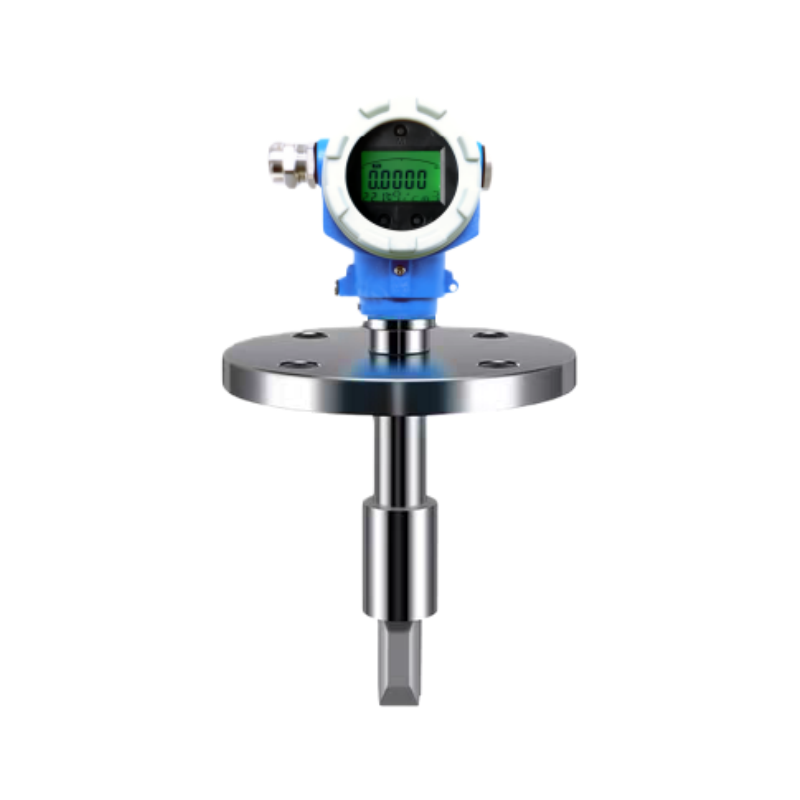
Product details:The online tuning fork vibrating density meter is an instrument designed for continuous, in-line measurement of liquid density. It enables fully integrated “plug-and-play, maintenance-free” density measurement. Primarily used in industrial process automation control, it finds broa
Product details:
The online tuning fork vibrating density meter is an instrument designed for continuous, in-line measurement of liquid density. It enables fully integrated “plug-and-play, maintenance-free” density measurement. Primarily used in industrial process automation control, it finds broad application in industrial settings such as in-line pipelines and open or closed storage tanks. The tuning fork density meter utilizes an acoustic frequency signal source to excite a metal tuning fork, causing it to freely vibrate at its center frequency. This frequency corresponds to the density of the contacted liquid. Consequently, liquid density can be measured by analyzing the frequency, with temperature drift in the system eliminated through temperature compensation. Concentration can be calculated based on the relationship between the measured liquid density and the corresponding density value at the measured temperature.
Measuring principle:
The tuning fork vibrating density meter sensor is composed of two piezoelectric crystals, one piezoelectric crystal generates vibrations, and the other piezoelectric crystal detects vibrations. The tuning fork sensor has a built-in temperature sensor to compensate for the vibrations of the piezoelectric crystals. When the liquid flows through the fork, the vibration changes, causing the resonant frequency to change. The resonant frequency is a function of the medium density:
ρ =K0+ K1T+K2T2
Where:
ρ - liquid density
T - vibration period of sensor output
K0,K1,K2 - sensor constants, calibrated at the factory
The sensor has a built-in PT1000 high-precision platinum resistance sensor with a resolution of 0.01 °C and an accuracy of 0.1 °C, and no calibration is required. In this way, the temperature change of the liquid can be detected in real time. It can be used to calculate the compensation coefficient of the liquid temperature effect.
Technical Parameters:
| Measuring range | 0 – 2.5 g /cc (0 – 2500 kg/m3),0~100.0% |
| Calibration range | 0 – 2.5 g /cc (0 – 2500 kg/m3),0~100.0% |
| measurement accuracy | ±0.5% |
| repeatability | ± 0.001 g /cc (± 0.1 kg/m3) ±0.1% |
| Operating temperature range | 0℃ ~ +150℃ |
| working pressure | 4mpa |
| Fluid Viscosity Range | 0 – 3000 cP |
| Temperature Coefficient | Less than 0.1 kg/m3 /°C (±0.5%) after correction |
| pressure effect | negligible |
| Built-in temperature sensor | Digital sensor, temperature compensation |
| Wetted material | 316L, 2205, 2507 Stainless Steel, Ha C, Titanium, PTFE/PFA |
| Fork Coating | Standard PTFE or PFA |
| Power supply | 24VDC, ≥50mA |
| Analog signal output | 4-20mA, 0-1000Hz, RS485 Modbus RTU HART |
| Output accuracy (20℃) | ± 0.1% of reading or ± 0.05% FS |
| Output repeatability (-40 ~ +85°C) | ± 0.05% FS |
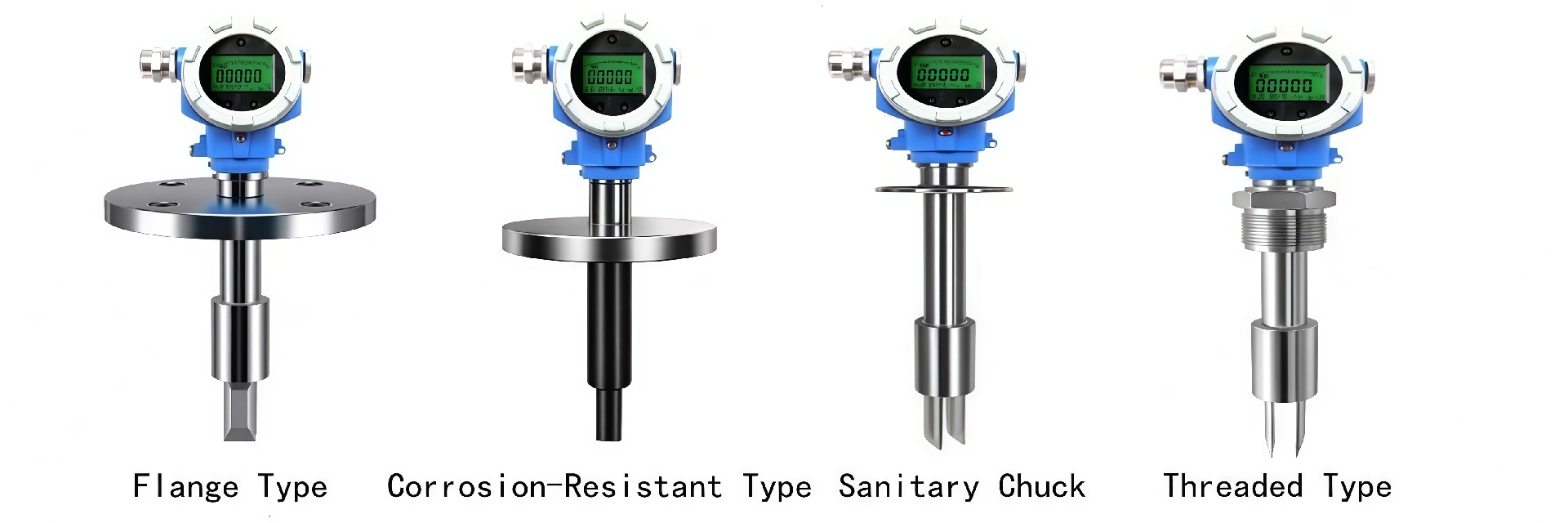
| process connection | DIN 50 PN16 G1.5″ Thread, 3″ Chuck, IDF and RJT Sanitary |
| degree of protection | IP65 |
| shell | aluminum alloy |
The sensor has
Application Industries:
Sugar and Brewing Industries: Extracting fruit juices, syrups, grape must, etc.; measuring alcohol proof, ethyl alcohol-water interface, etc.
Dairy Industry: Condensed milk, lactose, cheese, dry cheese, yogurt, etc.
Mining: Coal, potash, brine, phosphates, compounds, limestone, copper, etc.
Petroleum Refining: Lubricants, aromatics, fuel oil, vegetable oil, gasoline, diesel, etc.
Food Processing: Tomato juice, fruit juice, vegetable oil, starch milk, jam, fruit juice, beer, wine
Pulp and Paper Industry: Black liquor, green liquor, pulp washing, evaporators, white liquor, caustic soda, etc.
Chemicals: Acids, caustic soda, urea, detergents, polymer density, ethylene glycol, sodium chloride, sodium hydroxide, etc.
Liquids: Water, solutions, alcohol, petroleum, chemicals, liquid metals, etc.
Solutions: Brine, acid/alkali solutions, dissolved substances in organic solvents, etc.
Oils: Various lubricants, machine oils, edible oils, etc.
Chemicals: Various chemicals, solvents, acids/bases, nitric acid, phosphoric acid, acetic acid, chloroacetic acid, potassium hydroxide, sodium chloride, sodium sulfate, ammonium sulfate, ammonium bisulfite, ammonium chloride, ammonium cyanamide, ferric chloride, ammonia, hydrogen peroxide
Fuels: Gasoline, diesel, liquefied petroleum gas (LPG), aviation fuel, crude oil, kerosene, silicone oil, etc.
Organic Chemical Industry: Ethanol, methanol, ethylene, toluene, ethyl acetate, ethylene glycol, diluent water
Pharmaceuticals: Pharmaceutical intermediates, solvents, polyvinyl alcohol (PVA), citric acid, lactic acid
Semiconductors: High-purity solvents, detergents, isopropyl alcohol, butyl acetate
Printing and Dyeing: Sodium hydroxide, sodium carbonate, sodium bicarbonate
Equipment: Cutting fluids, emulsifiable oils, cutting oils, lubricants, antifreeze
Batteries: Hydrochloric acid, sulfuric acid
Other: Cement slurry, mineral slurry, oil/gas/water washing, kerosene, lubricating oil, oil/water interface, grinding fluid, etc.
Compatibility List(Part):
Name | Name | Molecular formula | Concentration(%) | 316L | Hastelloy | Titanium Alloy | zirconium | PTFE |
acid | Hydrochloric acid (excluding hydrofluoric acid) | HCI | 0-40 | × | × | × | × | ☆ |
sulfuric acid | H2SO4 | 0-50 | × | ○ | × | ☆ | ☆ | |
H2SO4 | 50-75 | × | × | × | ○ | ☆ | ||
H2SO4 | 75-98 | × | × | × | × | ☆ | ||
Nitric Acid | HNO3 | 0-100 | ○ | ○ | × | × | ☆ | |
Phosphoric acid | H3PO4 | 0-98 | × | ○ | × | × | ☆ | |
Alkali | Sodium hydroxide | NaOH | 0-50 | ☆ | ☆ | ☆ | ○ | ☆ |
Potassium hydroxide | KOH | 0-50 | ☆ | ☆ | ☆ | ○ | ☆ | |
Calcium hydroxide | Ca(OH)2 | 0-50 | ☆ | ☆ | ☆ | ○ | ☆ | |
Salt | Sodium chloride | NaCI | 0-50 | × | ☆ | ☆ | ○ | ☆ |
Ammonium chloride | NH4CI | 0-50 | × | ☆ | ☆ | ○ | ☆ | |
Ammonium sulfate | (NH4)2SO4 | 0-50 | × | ☆ | ☆ | ○ | ☆ | |
Other | Urea | (NH2)2CO | 0-100 | ☆ | ☆ | ○ | ☆ | ☆ |
Sodium hypochlorite | NaOCI | 0-16 | × | ○ | × | × | ☆ | |
hydrogen peroxide | H2O2 | 0-90 | ☆ | ☆ | ○ | ☆ | ☆ | |
☆Recommended ○Use under specific concentration and temperature limits × Do not use | ||||||||
Installation Method:
Tank Top Installation
Tank top installation is generally not recommended. It is only advised for buried tanks or tanks with only a top opening. When selecting the model, pay attention to the insertion depth. The minimum liquid level must be at least 70mm above the bottom of the tuning fork. During installation, ensure sufficient clearance from the tank wall and bottom: at least 50mm from the bottom and 100mm from the wall. Keep the sensor away from agitation or turbulence points, maintaining a distance of at least 200mm from such areas or install using a protective cover.
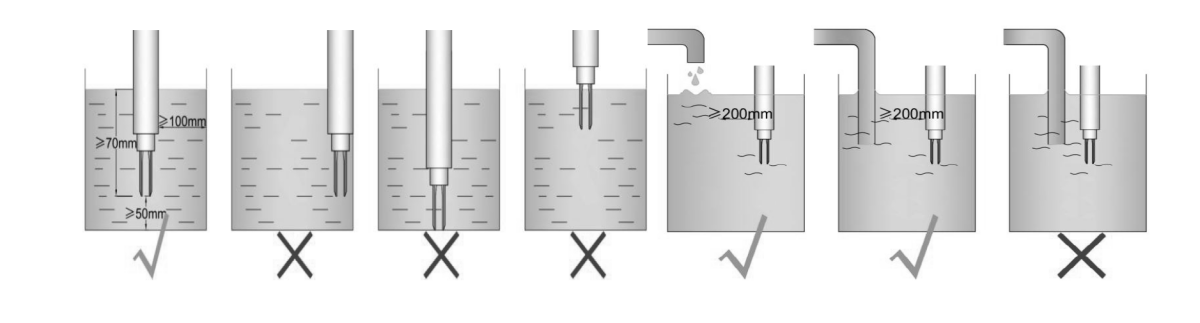
During installation, ensure the flow direction aligns with the direction passing through the gap in the tuning fork, or install using a protective cover. Keep the sensor away from sediment, maintaining a distance of at least 50mm from any deposits.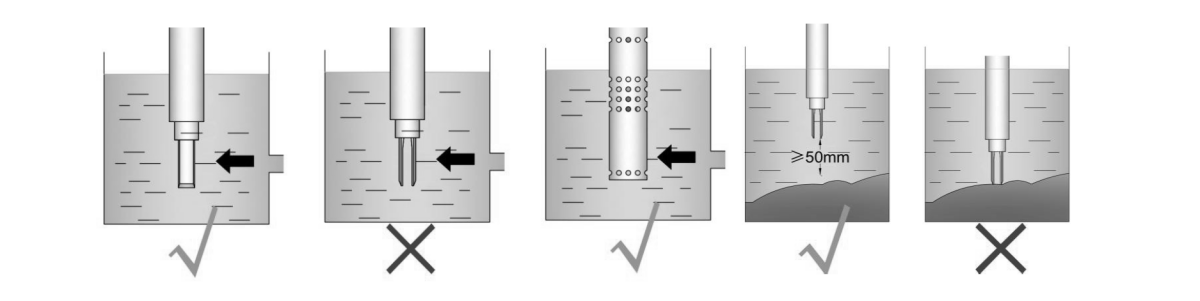
Tank wall installation
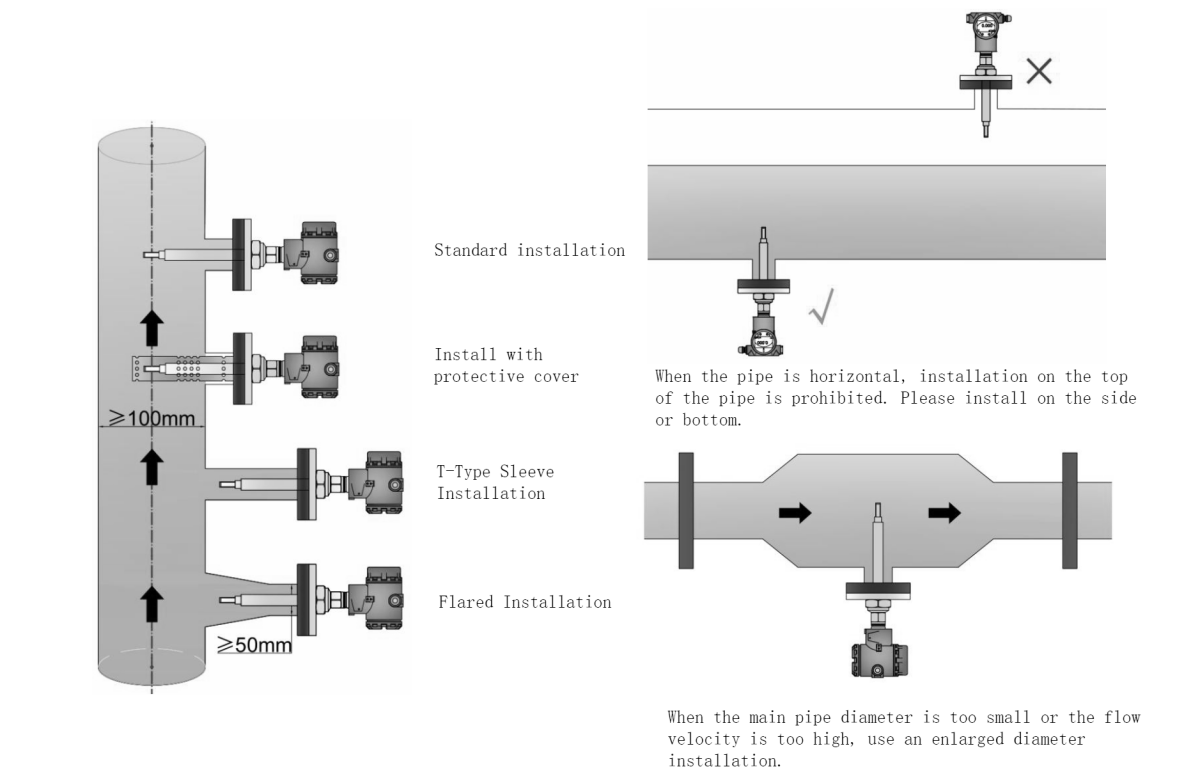
When no agitator is present in the storage tank, the tuning fork body may be installed directly inside the tank. When an agitator is present but no sedimentation occurs, installation using a protective cover or T-shaped sleeve is recommended. When both agitation and sedimentation are present in the storage tank, a bell-mouth installation must be used. The minimum inner diameter of both T-shaped sleeves and bell mouths shall not be less than 50mm. During installation and after completion, the gap of the tuning fork must remain vertically upward to facilitate bubble rise and solid sedimentation.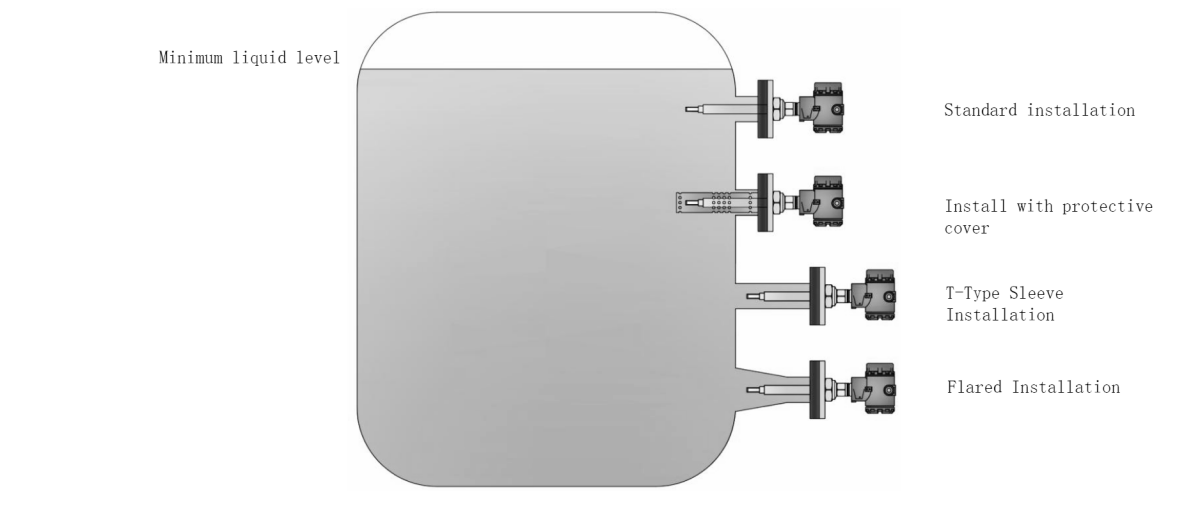
Pipe Installation
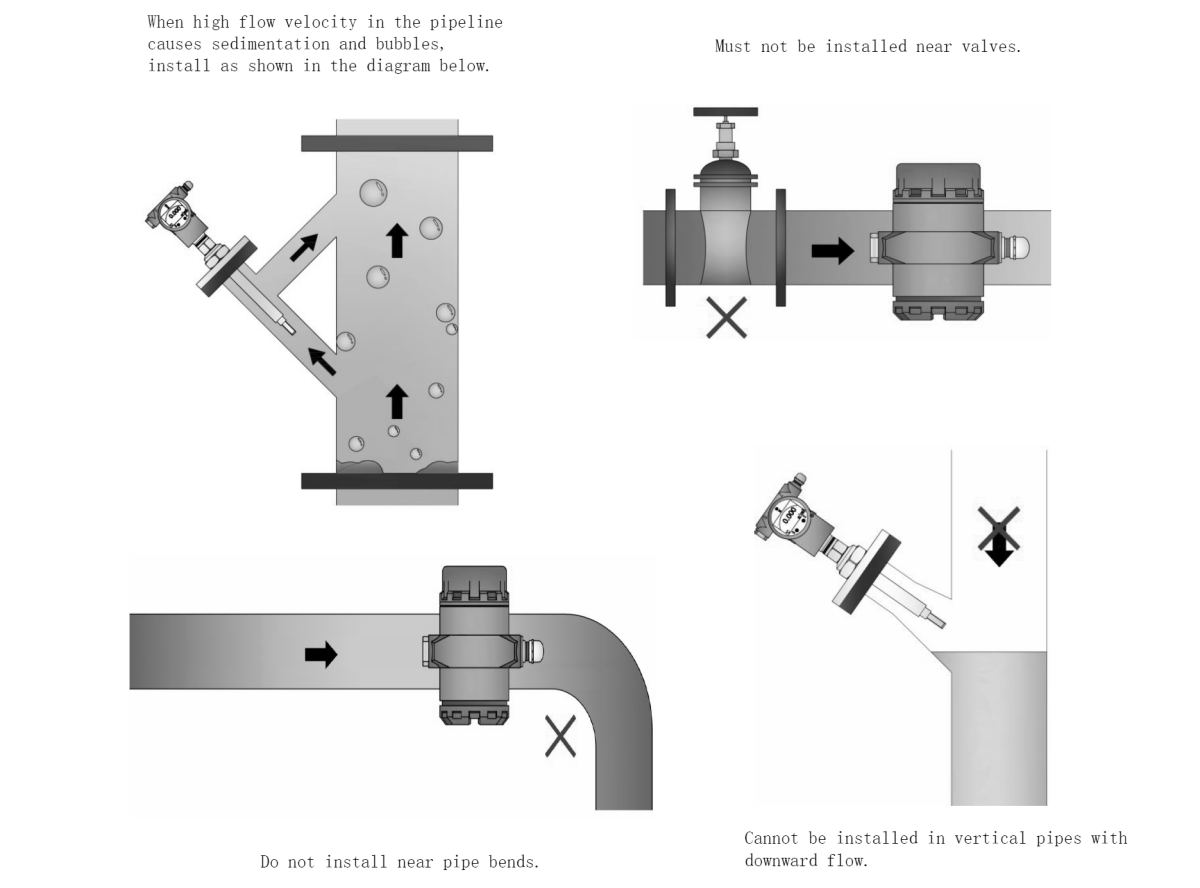
When the pipeline flow velocity is within 1 m/s, the device can be installed by insertion into the pipeline. Ensure the fork body gap is parallel to the liquid flow direction. Note that the pipe diameter must exceed 100 mm, and the pipe wall centerline must align with the fork body centerline. For flow velocities exceeding 1 m/s without sedimentation, install using a protective cover or T-shaped sleeve. For flow rates exceeding 1 m/s with sediment present, employ a bell-mouth installation. The minimum inner diameter must be at least 50 mm. During or after installation, the fork gap must remain vertically upward to facilitate bubble rise and solid sedimentation.